
When I was 16-years-old I worked a summer job doing odd jobs for a man and neighbor from church. Working alongside my best friend at the time, who is now my brother-in-law, we did everything from clean out trashed rental properties, to raking scum out of a pond, to basic maintenance around the farm. I distinctly remember one afternoon as the old man was giving us a tour of the limited supplies we had available to accomplish the day’s work, he paused, pointed at an ordinary 5-gallon bucket, and with great conviction told us, “that’s a good bucket.” I’ve never quite figured out how that bucket was supposed to help us tend to his rhubarb plants that I later inadvertently destroyed with a weedwacker, but I’ve never looked at a bucket again without uttering those same words: “That’s a good bucket.”
In Kentucky poet and farmer Wendell Berry’s 1988 essay, “The Work of Local Culture,” he describes lessons learned from a battered galvanized bucket. That’s right, a bucket. For years, Berry walked an old fencerow in a wooded hollow on what was once his grandfather’s farm. Hanging on a fence post was this old bucket that stirred a curiosity in Berry and moved him to stop and inspect its contents. That old bucket hung there through many seasons, collecting leaves, rain, snow, and nuts. Squirrels and mice found shelter in the bucket, stopping to eat their deposited nuts or to leave their droppings behind. Insects had flown into the bucket and died and decayed, birds had landed and left their own marks. For Berry, the slow work of growth and death, gravity and decay, which is the chief work of the world, had produced over time several inches of black humus, a deep rich soil in the bottom of that bucket.
Berry explains that he looks at that ordinary old bucket with fascination, not only because of the fact that it has contained the natural process of building earth – as is seen on the forest floor, in a farmed field, or on the top of a mossy rock – but he looks at that bucket as a marker of history and a promise of future. When he was a boy that bucket was carried out to the fields by hired hands. It once held tar, used to boil eggs, and carried water to thirsty neighbors helping his grandfather in the fields.
However trivial this old bucket might seem, Berry explains that for him, it is a sign by which he knows his country and himself. Not only does it collect leaves and other woodland sheddings, it collects stories too, as they fall through time.
Like that bucket, a human community must collect leaves and stories, and share those with one who might come strolling by that fencepost where the community hangs. A community must build soil, and build that memory of itself – lore and story and song – for that is its culture.
Lately I’ve been reflecting upon my family’s two years living in Dresden, Ohio. In the last two years we have seen incredible things happen in our community. We’ve seen a church revived, over 50 people proclaim their faith in Jesus through baptism, lives set free from the grips of anxiety, depression, and addiction, and we’ve seen a community spirit come alive. My family has set our roots down, made life-long friends, invested in the village, and have found a place here. We’ve found together that God is not done with Dresden. In the Spring of 2020, when I was preparing to move to Dresden, Ohio, I didn’t know a thing about this place and people I would come to love. My wife Jaci and I did a quick internet search and found a string of news articles about arson fires and of course aged write-ups about the glory days of basketmaking and retail consumers flocking to this little town. Digging a little deeper, I found the rich history of the Ohio canal system, Dresden’s farming heritage, and community festivals that we still celebrate today (I can’t wait for the Melon Festival this weekend).
Yet as we moved and settled in Dresden, I have found that this community has a far greater history that makes no mention of trade and commerce, it’s a history of neighbors helping neighbors. I recently read a piece about the malaria outbreak in 1828 in the early pioneer settlement that would become Dresden. In order to take care of families stricken by disease and death, early settlers sold nearly everything they had to nearby Shawnee and local traders in order to take care of those who couldn’t take care of themselves. I’ve read of church bake sales in the middle of the Great Depression to help a family without an income. I’ve read of Methodist, Baptist, and Presbyterian farmers coming together to harvest a neighbor’s crop when a family learned of the death of their son in war. Even today, I look forward to a good, old fashioned spaghetti dinner to benefit a family in the depths of a battle with cancer.
The sense of tight knit, neighborly community has always existed no matter the economic outlook. Now calling this place and people my home for the last two years, I realize that Dresden, and the church community that I am a part of, is not defined by baskets, or trade routes, or any external goods, its defined by our neighbors and the very spirit that brings us together as one.
As Wendell Berry mentions, a good local culture, in one of its most important functions, is a collection of memories, ways, and skills necessary for a community to thrive, even in the face of depression, recession, boom and bust, feast or famine. Like any of our local farmers will tell us, if the local culture cannot preserve and improve the local soil, then, as both reason and history inform us, the local community will decay and perish.
If a community is to thrive, we must hold our local memory in place. More and more country people, like city people, allow their economic and social standards to be set by television and salesmen and outside experts. Local culture though, has value. And what I’ve seen in the last two years is that when a community loses its memory, its members no longer know one another. Wendell Berry asks, “how can they know one another if they have forgotten or have never learned one another’s stories? If they do not know one another’s stories, how can they know whether or not to trust one another? People who do not trust one another do not help one another, and moreover they fear one another.” I think Berry identifies what our cultural predicament is today. We don’t know our neighbors. We don’t know their stories. We don’t know our community stories, and we don’t tell our own. And when we don’t tell our stories, our local history and future of community, loses its place.
And thus, in an age when we all gather around our televisions, our phones, and stay in our little echo chambers, it’s no wonder we’re left believing that we’re supposed to be divided and that our communities are in decay. Lacking an authentic local culture, a place is open to exploitation and ultimately destruction.
There was once a day, when the day’s work was over, that we didn’t huddle inside around a screen, but we gathered on the front porches of our neighbors and told stories of those who came before us, stories of God’s faithfulness, stories that made us laugh and cry, stories that made us vulnerable and offered a window into who we are as people.
Today, people feel more disconnected, depressed, anxious, and isolated than they ever have. In 2021, Harvard conducted a study where they found that 36% of Americans are experiencing severe loneliness and isolation. And those experiencing loneliness and disconnection, even in an age when we are so connected digitally, are more likely to experience the steep costs of loneliness, including early mortality and a wide array of serious physical and emotional problems, including depression, anxiety, heart disease, substance abuse, and domestic abuse.
However, Dresden has shown me that maybe there is hope. Maybe God isn’t done with us. Maybe God hasn’t left us to our anxieties and isolation. Maybe He is calling us home, with Him, with one another.
Wendell Berry makes a controversial statement, claiming that if improvement is going to begin anywhere, it will have to begin out in the country and in the country towns. I’ll add to that and say this, if the last two years is any indication of what God has in store, if we want to see improvement in our world, it will have to begin in places like Dresden. This isn’t because of any intrinsic virtue that can be ascribed to rural people, it’s not because of baskets or any good we can produce, but it is because we still have the remnants of local memory and local community. There are still farms and small businesses, there are still homecomings and melon festivals, there are faith communities like ours, that don’t rely on external voices dictating from afar, but can be changed according to the will and desire of individual people.
I believe that one revived rural community, not revived around economics, but revived in spirit, the same spirit that has Dresden Methodist booming, would be more convincing and more encouraging than all the government and university programs in the last 50 years. To quote Berry, “To be authentic, a true encouragement and a true beginning, this would have to be a revival accomplished mainly by the community itself. It would have to be done not from the outside by the instruction of visiting experts, but from the inside by the ancient rule of neighborliness, by the love of precious things, and by the wish to be home.”
There is hope in community. There is hope in our community. There is hope where one finds home.
So, I want to leave you with the words of Jesus to the disciples in Acts 1. Jesus said, “But you will receive power when the Holy Spirit comes on you; and you will be my witnesses in Jerusalem, and in all Judea and Samaria, and to the ends of the earth.”
With the power of the Holy Spirit, we’re called to be witnesses. Witnesses, not evangelists, apologists, pastors, preachers, teachers, theologians, witnesses. We’re called to simply tell our story. We’re called to be neighbors. To gather on our porch, around the dinner table, to help out a neighbor, to sit down for a cup of coffee, and tell our story. Because our story is God’s story. Dresden’s story is God’s story. Your story, is God’s story, with all the good, the bad and the ugly. So, take some time to slow down, gather with a friend, and tell a couple of tall tales. Grab a good bucket as a seat, tell a story, and start building the community that awaits you and your story. Tell a story and be a good neighbor.
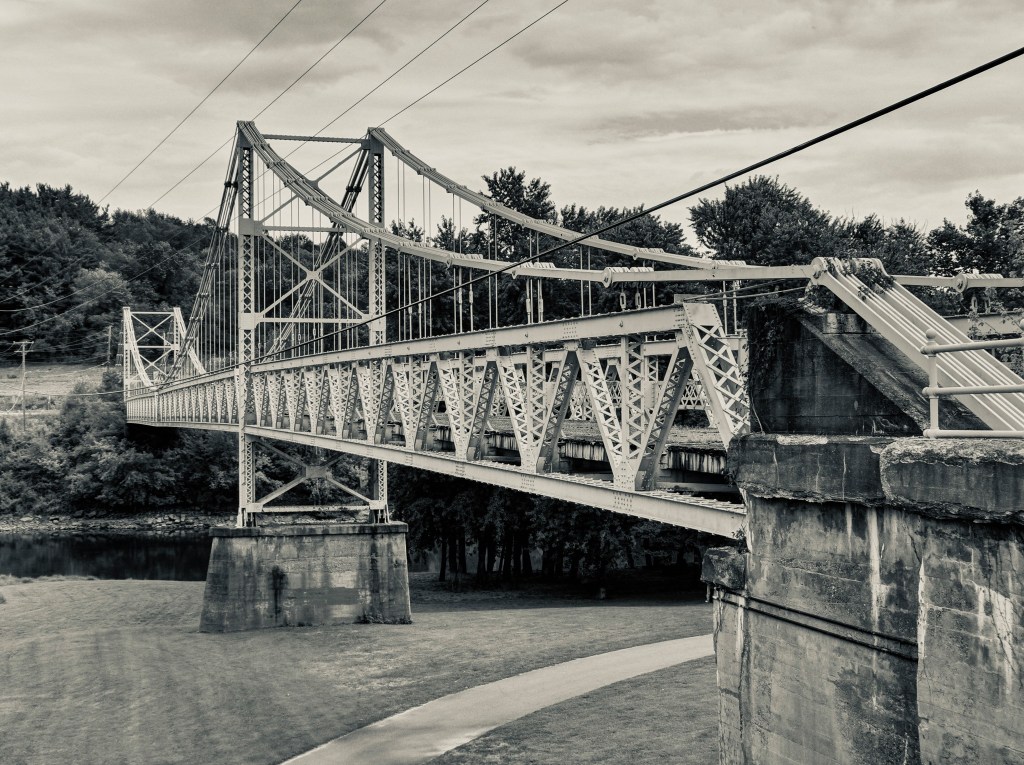
 Dresden Church